
September 24, 2026
A buyer widening a Main Line search this month might type "Merion Station" into three different home search sites in the same afternoon and come away with three different numbers. One site says the median sale price is $750,000, down almost 5 percent from a year ago. Another says $975,000, up 8 percent. A third pegs the median list price at $1.1 million. Same town. Same month. A $350,000 spread on what "median" is supposed to mean.
None of those numbers is wrong. Each one is drawing from the same underlying market, just catching it at a different moment, a single month here, a rolling twelve months there. In most towns that produces a rounding difference. In Merion Station that matters more than it would almost anywhere else on the Main Line, because Merion Station isn't one housing market. It's two, and they rarely compete for the same buyer.
Look at what actually closed in Merion Station over the winter. A unit at 415 City Ave sold on December 19, 2025 for $340,000, a 3-bedroom condo just under 1,500 square feet. Eleven days later, a stone estate on General Lafayette Road closed at $2,835,000, a 5,646-square-foot house on a lot approaching an acre after 161 days on the market. Less than a week into the new year, a 5-bedroom on Brookway Road sold for $2,291,750 after 54 days.
Three sales, three weeks, a spread of nearly $2.5 million. Average those together and you get a number that describes none of them.
That's the mechanism behind the conflicting medians a buyer sees online. A median is only a stable measure when the underlying population is one population. When it's two, the number swings on which mix of properties happened to close in whatever window a given site is measuring. A month where a Latch's Lane condo and two entry-level twins close pulls the median down. A month where three stone Colonials on the estate corridors close pulls it up. Nobody is wrong. The math is doing exactly what medians do when you feed them a bimodal market.
The condo side of Merion Station has a name, several names actually. Latch's Lane Condominiums is the anchor, a seven-story building completed in 1948 with 81 units. Its 2-bedroom units, running 973 to 1,458 square feet, are currently priced between $333,000 and $486,513. A short walk or drive away sit its sister buildings: Merion Manor, Yorklynne Manor, and Sutton Terrace. Townhouse-style listings in the neighborhood have recently priced in the $495,500 to $518,000 range. None of these buildings has a township-wide homeowners association pooling them together. Each runs its own condo association, its own fee structure, its own capital assessment schedule.
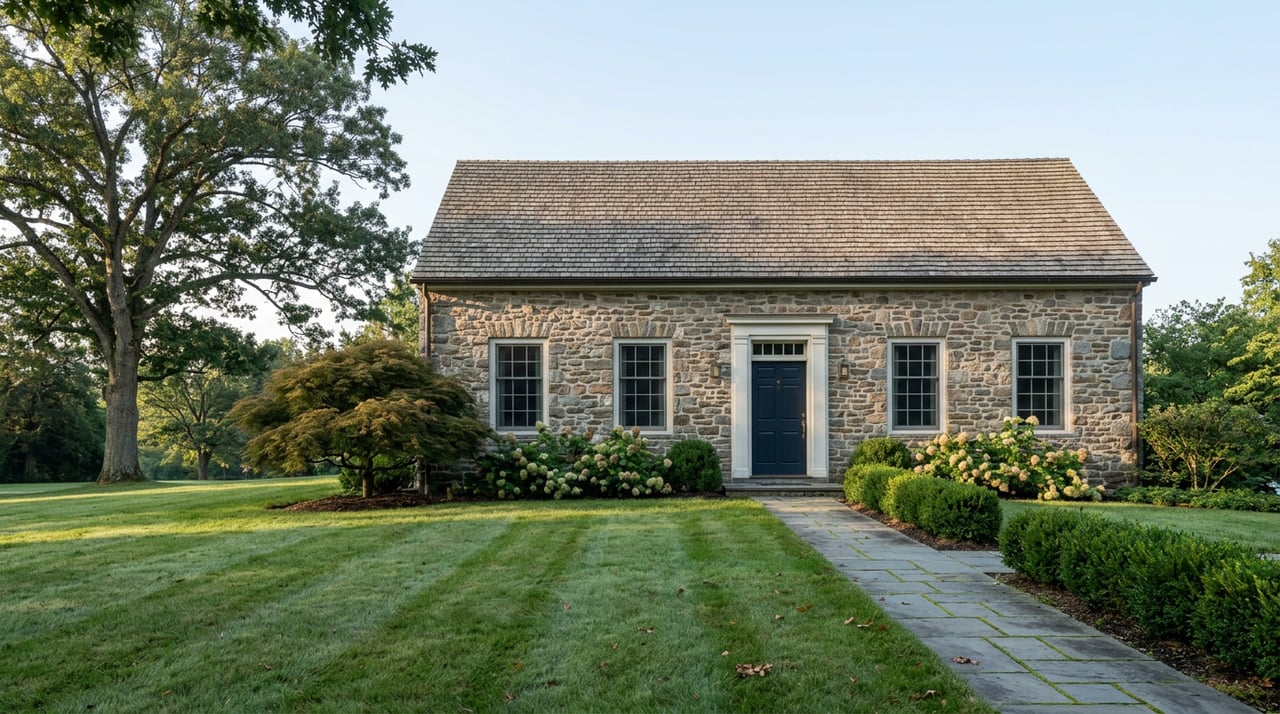
The estate side has street names instead of building names. General Lafayette Road and Brookway Road anchor a corridor of stone Colonials and Tudor-influenced homes on lots that stretch toward an acre, the kind of scale that supports a carriage house or a pool without crowding the property line. A local market profile of the area found detached single-family lots in Merion Station ranging from under a quarter-acre on interior streets to nearly an acre or more on those estate corridors, which is a wide enough range on its own to explain a lot of price scatter before you even factor in the condos.
Here's what that split looks like when you separate it out:
| Segment | Anchor buildings or streets | Recent price evidence | What moves price inside it |
|---|---|---|---|
| Condo / mid-century | Latch's Lane, Merion Manor, Yorklynne Manor, Sutton Terrace | 2BR units $333K-$486,513; recent close near $340K | Floor level, unit size, renovation age, association fee and any pending capital assessment |
| Estate / stone Colonial | General Lafayette Road, Brookway Road corridors | Recent closes $2.29M-$2.835M | Lot size and privacy, restoration completeness, proximity to the golf club versus the train |
A buyer comparing these two rows to each other is comparing two different products. A buyer comparing either row to the town-wide median is comparing it to something that doesn't exist as a purchasable home.
Inside the condo buildings, the variables are the ordinary ones: which floor, how many bedrooms, whether the kitchen has been touched since the building went up, and what the association fee covers. Latch's Lane residents get a gym, an outdoor pool, a social room, and both indoor and outdoor parking options, along with a Shabbat elevator that speaks to who has called this building home for decades. None of that shows up in a square-footage comparison, but it shows up in the closing price.
Inside the estate corridors, the variables run the other direction. A stone house on General Lafayette Road or one of the neighboring estate streets is being priced on privacy and scale as much as square footage. Merion Golf Club sits adjacent to the neighborhood, a course that has hosted five U.S. Opens and holds a USGA-confirmed championship schedule through 2050, and that proximity is part of what these corridors are selling, whether or not a buyer plays a round.
The two segments also commute differently. The SEPTA Paoli/Thorndale Regional Rail line stops directly in Merion Station and reaches Center City Philadelphia in roughly 10 minutes, on what was historically SEPTA's highest-ridership regional rail line. That's a real asset for someone in a condo two blocks from the platform. It's a much smaller factor for someone on a private acre who's driving into the city anyway.
There's an older thread running under both segments that's easy to miss. The Merion Civic Association was organized in 1913, before either the condo buildings or most of the stone Colonials existed in their current form, and the Barnes Foundation itself was originally located in Merion before relocating to Philadelphia. A neighborhood that's been organizing around its own character for more than a century tends to end up with layers instead of a single texture, and that's exactly what shows up in the price data today.
If you're cross-shopping Merion against Gladwyne, Wynnewood, or Villanova, the town-wide median is the wrong number to anchor on in any of these places, but it's especially misleading in Merion Station because the two segments are so far apart and so evenly represented in the data. A buyer who wants a condo near the train should be comparing Latch's Lane and its sister buildings against similar mid-century buildings in Wynnewood or Bala Cynwyd, not against a townwide average that's half stone estate. A buyer set on a half-acre stone Colonial should be pricing against General Lafayette Road and Brookway Road, or against comparable estate streets in Gladwyne, not against a number that's half condo.
The practical move is to ask which segment you're actually shopping before you look at a single median. Once you know that, the town-wide number stops being useful and the comparable sales inside your segment become the only ones worth studying.
Is Merion Station affordable? It depends entirely on which Merion Station you're looking at. The condo buildings put a foothold in the neighborhood within reach of a much wider range of buyers than the estate corridors do, and the two segments shouldn't be evaluated against the same budget assumption.
Why do listing sites disagree so much on the median? Because each one is averaging whatever mix of condo and estate closings happened to fall inside its measurement window. A window heavy on condo closings pulls the number down. A window with a couple of stone Colonials in it pulls the number up. Neither site is miscounting. They're just catching the market at different moments in a market that swings hard between its two halves.
Do the condo buildings have their own fees to budget for? Yes. There's no township-wide association covering Merion Station. Latch's Lane, Merion Manor, Yorklynne Manor, and Sutton Terrace each run their own condo association with its own fee schedule, and some have posted capital assessments in addition to monthly dues. That's worth asking about before you fall in love with a floor plan.
Does the estate corridor pricing hold up on smaller lots? Not automatically. The estate-corridor prices reflect lot size and privacy as much as house size, so a smaller lot on one of these streets won't command the same number even with a similar house on it.
If you're trying to figure out which Merion Station actually fits your budget and your list, that's exactly the kind of conversation worth having before you start touring. Jordan Arnold works this stretch of the Main Line block by block, not just by the headline number, and can walk you through which comparable sales actually apply to the home you're picturing. Reach out to schedule a confidential consultation or request a free home valuation to see where your specific property or search fits into either side of this market.
His meticulous attention to detail and direct approach ensure that each transaction is conducted with efficiency and professionalism, distinguishing him as a standout figure of excellence within the business community.