
August 27, 2026
Most people who live within a mile of Merion Road know the general shape of the block. The low stone retaining wall. The gap in the trees where the railroad runs behind it. A patch of green that reads, from a moving car, like the side yard of a house you can't quite see. Few stop. Fewer still know that what sits behind that wall is public, free, and older than most of the homes around it: a 13.5-acre botanical park built specimen by specimen since 1944, currently in the middle of a physical overhaul that most of Merion hasn't noticed yet.
That's the thing worth knowing if you already live here. Merion Botanical Park isn't a pocket park with a bench and a swing set. It's a working plant collection, tended by a nonprofit society older than the interstate highway system, and it's changing under everyone's feet this year.
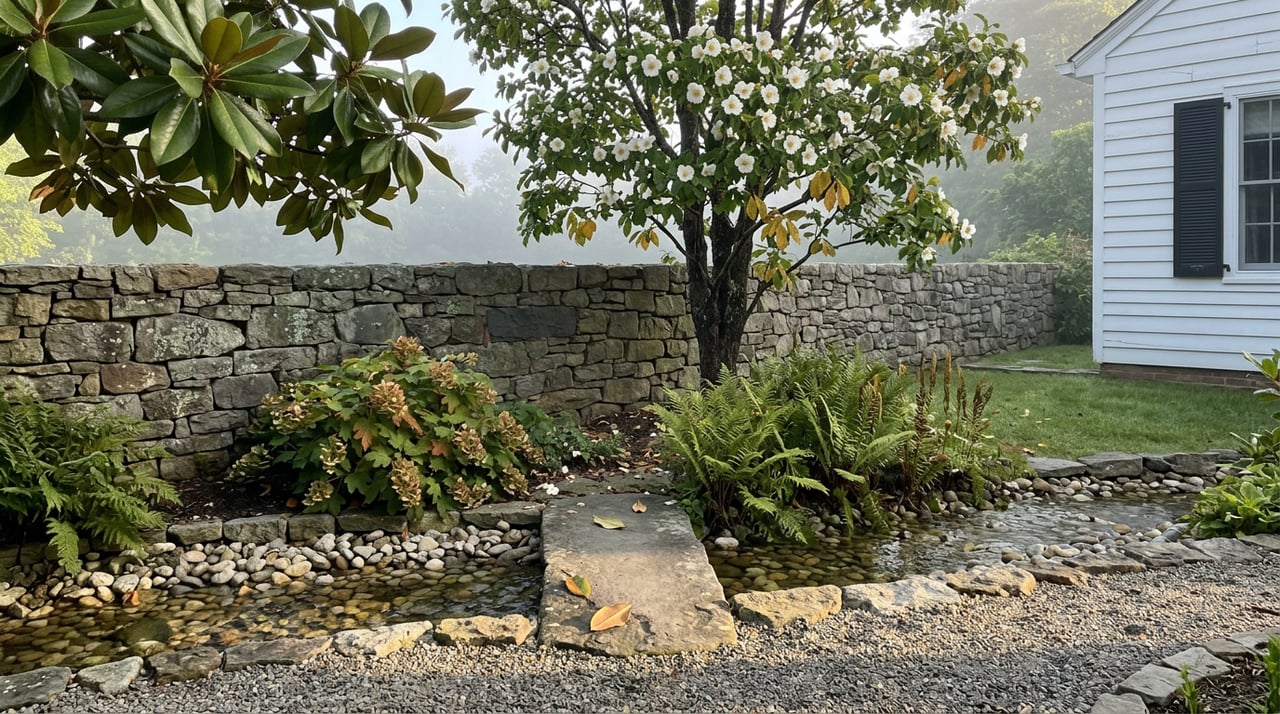
The park sits at 100 Merion Road in Merion Station, wedged between the railroad tracks and a residential block, open every day of the year with no admission and no gate hours to remember. The confusion is understandable. There's no parking lot to signal "public amenity," no playground equipment, nothing that reads as civic infrastructure from the street. What you actually get, once you walk in, is a stream that splits the property into two distinct halves: a manicured lawn side with gravel paths, benches, and specimen trees planted with intention, and a narrower, wilder strip between the water and the tracks left to grow the way a forest edge grows when nobody manages it too closely.
That split isn't accidental. It's the result of eight decades of a volunteer group deciding, tree by tree, what belongs where.
Late summer in the park means azaleas and dogwoods are long past their spring show, but the collection is built for more than one season. Cut-leaf maples hold their color into fall. Redbuds, magnolias, rhododendron, and viburnum fill out a plant list that reads less like a township park inventory and more like an arboretum's. Two specimens are worth detouring for specifically: a Franklinia tree, a species so rare in cultivation that most people will never see one outside a botanical garden, and what visitors have taken to calling the "umbrella tree" for its oversized leaves, almost certainly a bigleaf magnolia given the description.
Here's the part that makes the collection more than pretty: the trees are tagged. Botanical signs with QR codes let anyone standing in front of a trunk pull up detailed information about what they're looking at, a small but real piece of infrastructure that turns a walk into something closer to a self-guided lesson. Bird nest boxes are placed throughout the grounds, and a Monarch Way Station installed in 2014 gives the property a working role in pollinator corridors that stretch well beyond Lower Merion Township's borders.
The park exists because a small group of residents decided, in 1944, that Merion should have somewhere like this. The Botanical Society of Lower Merion bought an abandoned lot and then convinced the township to buy the parcel next to it, stitching the two together into what is now township-owned land that the Society still manages and maintains. Among the founders was Laura Barnes, wife of art collector Albert C. Barnes, whose name is more commonly attached to the Barnes Foundation's collection of paintings a few miles away than to a stream-side garden of native trees. It's a quieter legacy than the one most people associate with that family, but it's the one still growing on Merion Road eighty-two years later.
The Society's founding language holds up better than most mission statements from that era:
"Trees outstrip most people in the extent and depth of their work for the public good."
That line, drawn from the Society's own materials, is the closest thing the park has to a thesis statement, and it explains why the collection has always prioritized rare and unusual specimens over easy, low-maintenance plantings.
The park wasn't always the tidy, tagged collection it is now. By the early 2010s, neglect had caught up with it. The turnaround began in 2012 under a volunteer known locally as "Botanical Bill" Earley, who organized what amounted to a citywide cleanup crew: Montgomery County inmates, rabbinic students, Boy Scouts, ROTC members, and Little Leaguers all working the same afternoon to haul out roughly 1,000 pounds of accumulated trash. That renewal is the reason the park you'd walk through today looks like a maintained collection rather than an overgrown lot behind a stream.
The Society has kept at it since. Recent monitoring efforts have focused on spotted lanternfly activity concentrated on the park's Tree of Heaven specimens, with the USDA testing different trap designs on-site to see which ones catch the invasive insect without harming birds or mammals that share the same trees. It's a small, ongoing example of the kind of maintenance that doesn't show up on a sign but keeps a specimen collection from quietly losing the plants that make it worth visiting.
The most visible change happening right now is underfoot. Lower Merion Township has completed a trial section of the park's main path using porous paving material, a surface designed to let stormwater filter through rather than run off, and the plan is to test how it holds up through heavy rain and water flow before deciding how far to extend it. More paving along the path is anticipated later in 2026. If the last time you walked the loop was a year or two ago, the surface under your feet on the eastern half of the property may already look different, and more of it will by the time the leaves turn again.
Separately, Aqua Pennsylvania has plans in motion for a new pipeline intended to serve increased water demand south of the existing SEPTA rail lines, a detail that matters less for a weekend walk and more as a reminder that the park sits inside a working piece of township infrastructure, not a museum piece frozen in 1944.
Walk two minutes from the park entrance and you land at the Merion Tribute House, an Arts and Crafts hall on Hazelhurst Avenue that's hosted Main Line social events since 1924. It's easy to drive past this one too, mostly known these days for weddings, but its civic calendar tells you something about how Merion actually organizes its year. The Merion Civic Association holds monthly meetings there, and each spring turns the grounds over to neighbors for "Cars and Trucks and Things That Go," a car show that drew local enthusiasts this past April. The Association's next meetings are set for September 22 and October 27, 2026, and past sessions have brought in speakers like the Botanical Society's own president to talk about what's changing in the park down the street.
A few minutes further and you're at the Merion Meeting House, built in 1695, which makes the botanical park's eighty-two years look almost recent by comparison. Between the two buildings and the garden connecting them, this stretch of Merion Station holds more continuous local history in a half-mile than most people who commute past it every day realize.
None of this shows up on a real estate listing, and it shouldn't. But it's the kind of texture that tells you what a place actually is once you've lived there long enough to stop just driving through it. If you're weighing a move within Merion, thinking about what your own property might be worth, or simply curious what else is changing in the neighborhood this year, Jordan Arnold has spent his career paying attention to exactly these details. Reach out for a confidential conversation about the market, or ask for a free home valuation whenever you're ready to see where things stand.
His meticulous attention to detail and direct approach ensure that each transaction is conducted with efficiency and professionalism, distinguishing him as a standout figure of excellence within the business community.